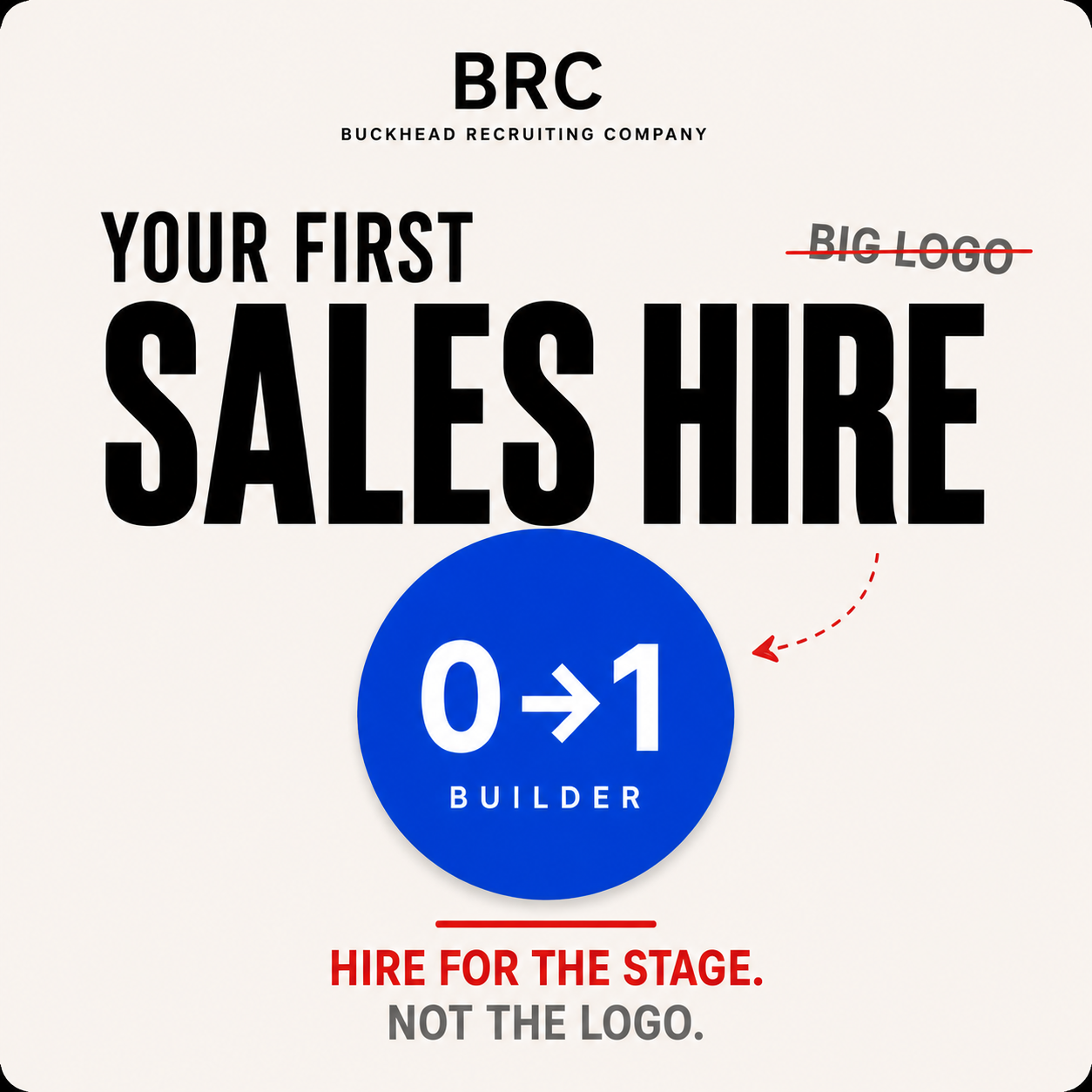
For founders, making the first sales hire can feel like a major milestone. You have proven that customers will pay for the product, you have started to see patterns in who buys it, and sales are taking up more and more of your time. Eventually, the question becomes unavoidable. Who should I hire to help turn founder-led sales into something repeatable? The obvious answer might seem to be the person with the strongest sales resume. Maybe they previously worked at a recognizable company where they consistently hit quota, and had years of experience selling successfully. But there is a problem with that approach. The best salesperson on paper is not necessarily the best first salesperson for your company.
The first sales hire is fundamentally different from adding another salesperson to an established sales organization. They may not have a recognizable brand behind them, a steady stream of inbound leads, a team of SDRs generating meetings, mature messaging, or a well-established sales process to follow. Instead, they are walking into an environment where much of that still has to be built. If you hire for the wrong reasons, you may end up having to replace that new sales hire, inevitably causing you to backtrack. The better question is:“Who is the best salesperson for the stage my company is in right now?”
Before deciding who to hire, founders should first determine whether they are ready to make the hire at all. At this stage in the company, the founder has moved beyond the earliest stage of simply trying to figure out whether anyone will buy. Customers have demonstrated that they are willing to pay. The founder has an emerging understanding of the ideal customer, and there are signs that sales are becoming repeatable across more than one customer.
There is no magic ARR number that tells a founder it is time to hire sales.
The stronger signal is whether the company has learned enough through founder-led selling to understand who buys, why they buy, what objections consistently come up, and how deals actually get across the line. Bain Capital Ventures makes a similar argument, founders should establish meaningful traction and a repeatable sales motion before bringing on their first AE. In conversations with early-stage founders, BCV found that repeatability showed up when the same sales conversations consistently surfaced the right pain points and qualified prospects moved through similar stages.
Bessemer Venture Partners similarly recommends that founders win their earliest customers themselves before trying to scale the motion. That founder-led period helps the company refine its ideal customer profile, understand buyer pain points and objections, and begin turning those lessons into a repeatable sales process that another seller can eventually inherit.
In other words, revenue can be a useful reference point, but repeatability matters more than crossing an arbitrary threshold.
At the same time, the founder is still personally responsible for most of the selling. That creates an issue. The founder may be spending too much time prospecting, taking sales calls, following up with leads, and closing deals when they need to be focused on other parts of the business so it can continue to grow. The goal of the first sales hire should be to help move the company from founder-led sales toward a repeatable sales motion.
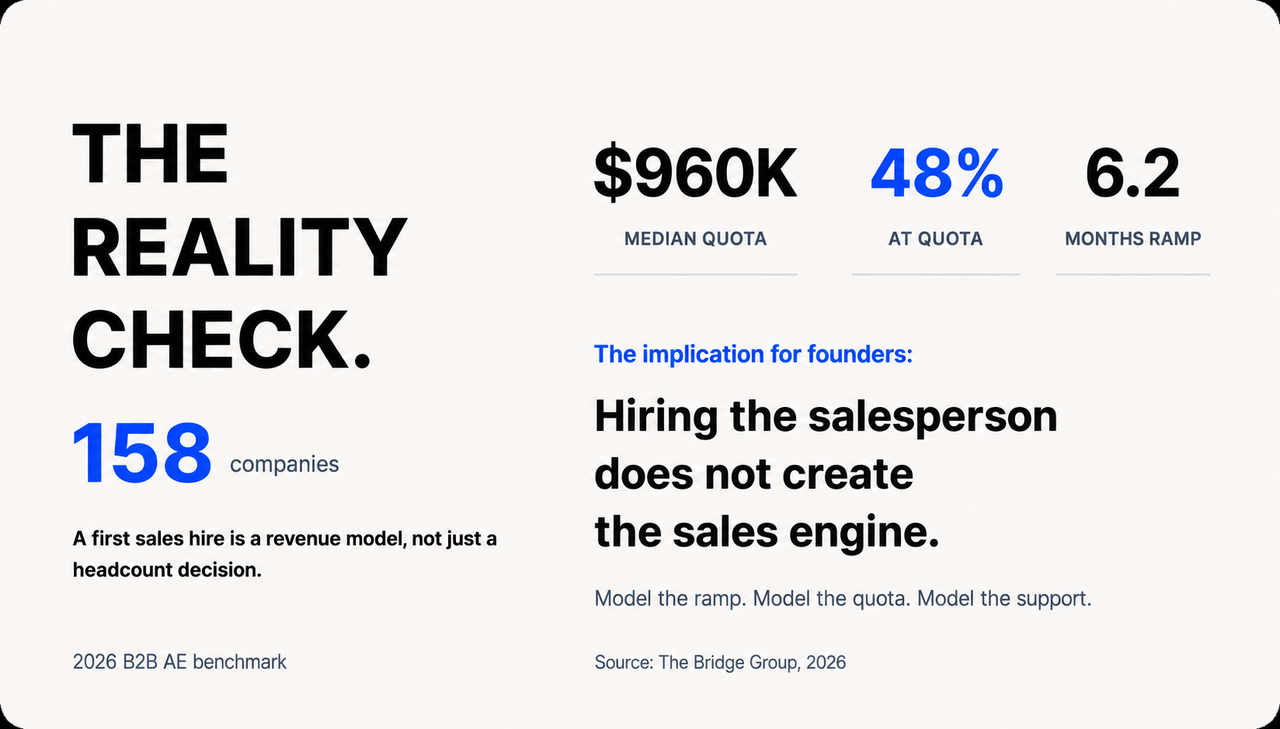
The same thinking applies to the financial side of the hire. Founders need to consider whether the business can realistically support the cost of the hire and what they can reasonably expect them to produce. Across 158 B2B companies, the 2026 benchmark puts the median Account Executive quota at $960,000 with $200,000 on target earnings (OTE). However, only 48% of the reps hit quota, and the average ramp time is 6.2 months. This means founders shouldn't automatically assume that a new sales hire will immediately generate enough revenue to cover their cost. Instead, they need to account for the ramp period and set realistic expectations for when the hire will begin contributing meaningful revenue. Ultimately, the decision should come down to whether the business has enough financial runway to support the hire while they ramp and whether the potential revenue justifies the investment.
Essentially, it comes down to how repeatable the sales process actually is. If the founder is still figuring out who the customer is, changing the product or messaging regularly, or relying heavily on their own involvement to close deals, bringing in a salesperson may be premature. The new hire can help build on a sales process that is already starting to work, but they cannot be expected to figure out the entire foundation of the sales motion on their own.
At BRC, we have seen several patterns emerge when companies make their first sales hire. The problem is not always that the salesperson themselves is bad, sometimes the person and the environment just don't mesh well.
One of the easiest mistakes a startup can make is assuming that success at a recognizable company will automatically transfer to a startup. A salesperson may have an impressive track record at a large organization. But that success may have been supported by things that will not exist at a smaller company like brand recognition, inbound pipeline, SDR support, sales enablement, mature messaging, established processes, and a large customer base. That doesn’t mean the salesperson wasn’t successful. It means the founder needs to understand what actually contributed to that success. At a startup, the salesperson may have to create their own pipeline instead of waiting for leads. They may have to figure out the messaging instead of receiving a pitch in their inbox. They may need to build that process instead of following one. A strong seller who depends heavily on an established sales infrastructure may struggle when that infrastructure disappears.
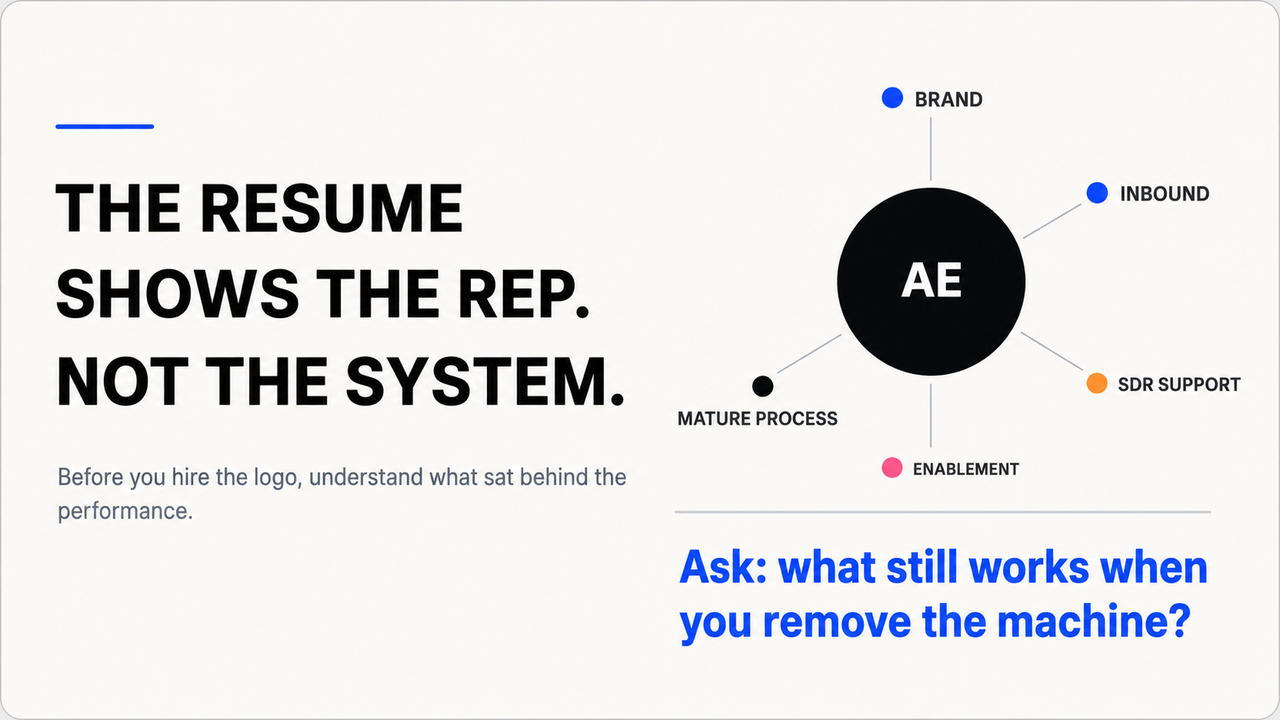
We’re not saying that sales candidates coming from bigger companies can't succeed at a startup, but the skills they learned from that company may not be transferable to a startup environment.
“Founders often evaluate the salesperson without evaluating the environment that made that salesperson successful.” — Silee Williams, Buckhead Recruiting Company
Mistake #2. Hiring for where you want to be instead of where you are
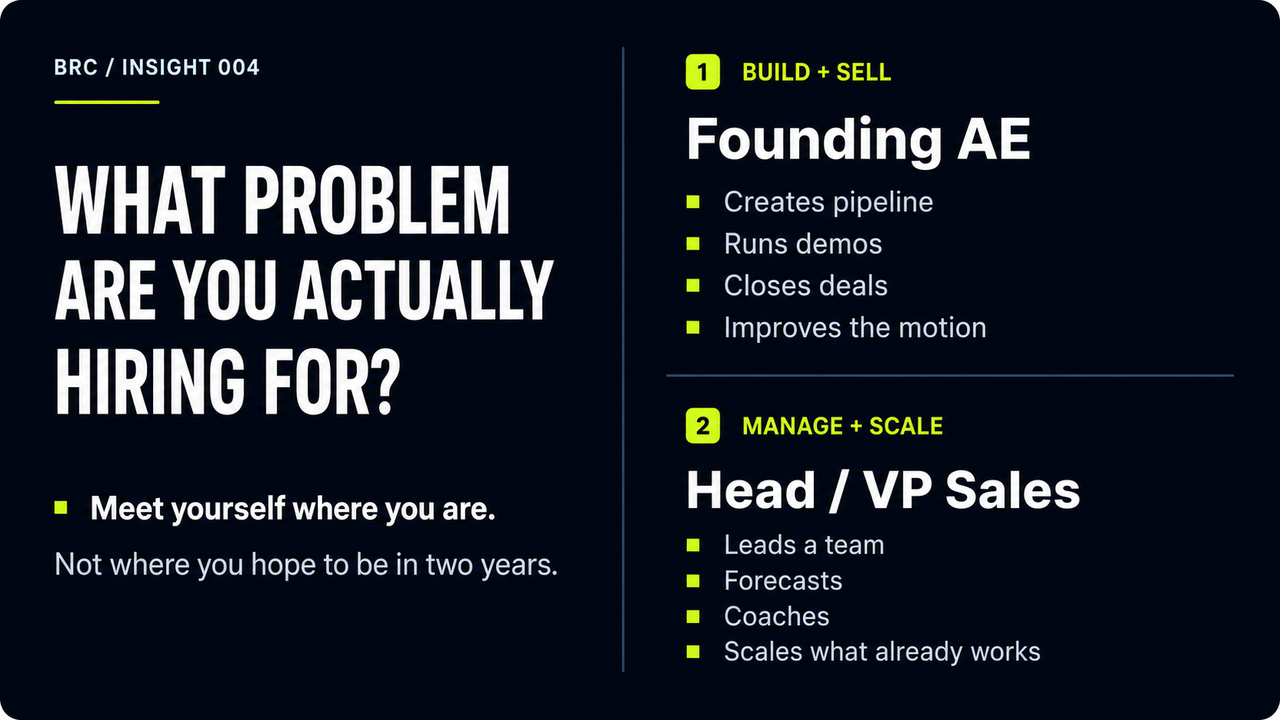
Founders often hire for the company they imagine having six months or two years from now rather than the company they have today. Meet yourself where you are. A 10-person company does not need to hire as though it already has a 50-person sales organization. The sales problems are different. If there is no sales team to manage, hiring someone primarily because they have experience managing a large sales organization may not solve the immediate problem. The first question should be, What does the business need this person to accomplish right now? Hire for the sales problems you have today, not the org chart you hope to have two years from now.
Mistake #3. Hiring leadership too early
Another common mistake is assuming the first sales hire needs to be a Head of Sales or VP of Sales. Sometimes it does. Often, it does not. When your company needs someone to prospect, take meetings, demo the product, follow up, close opportunities, and help build the sales process, it may need a hands-on seller rather than a sales executive managing a team that does not yet exist. A title does not create a sales organization. Before hiring for leadership, founders should ask whether they actually need someone to manage and scale or whether they need someone who can build and sell. For many early-stage startups, the immediate need is the latter.
The first salesperson cannot be expected to solve product-market fit, positioning, pricing, messaging, process, and the entire sales strategy while also carrying a quota. At the end of the day, the founder still plays an important role because the salesperson will need knowledge and direction that still lives with them. If the founder hands over sales and expects immediate results without staying involved, the salesperson can burn out, or the company may end up back at square one.
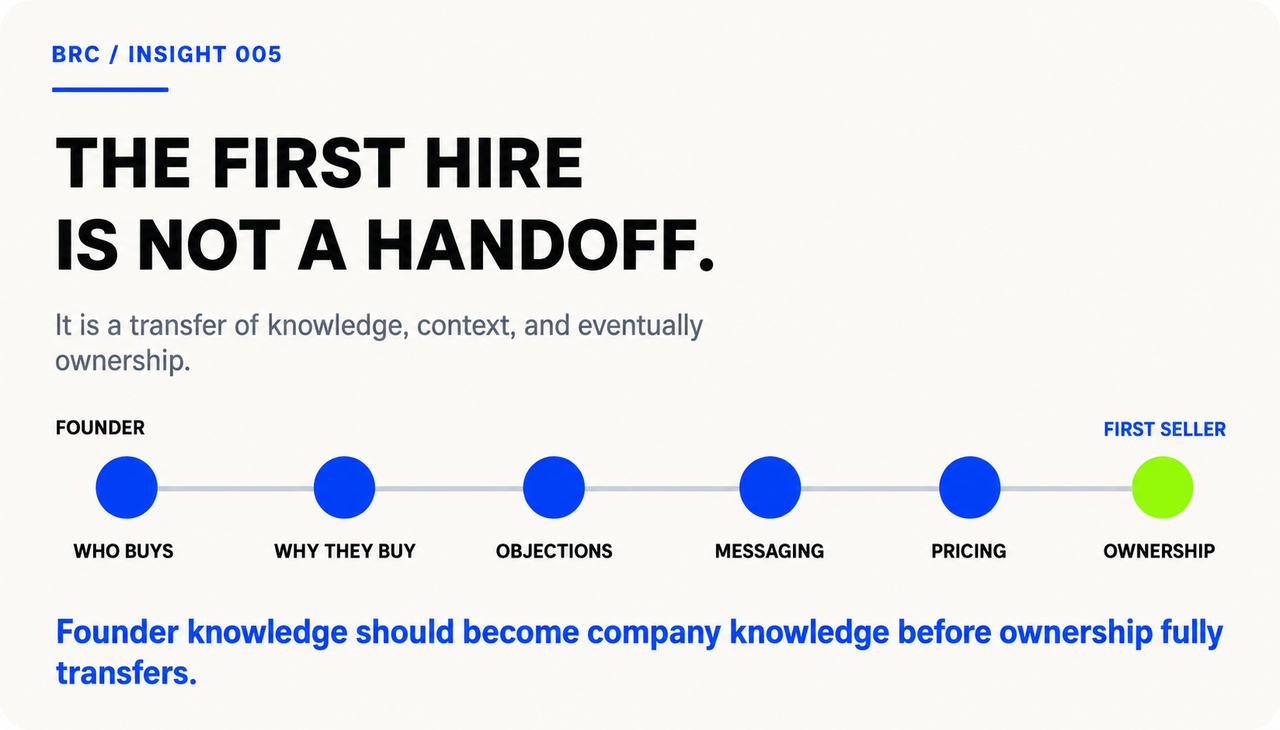
Hiring a salesperson does not mean the founder should immediately stop selling. The first sales hire needs time to learn the product, understand the customer, develop credibility, and learn what works. The founder’s involvement during this period is valuable. Selling together allows knowledge to transfer and gives the founder a chance to observe how the new hire handles real conversations. We’ve seen companies begin evaluating a new sales leader within the first week, before that person has had enough time to understand the product, buyer, and sales motion. When average AE ramp is measured in months, not days, expecting meaningful results in the first week is unrealistic. Hiring someone into sales is not a handoff. Founders still need to transfer their knowledge and give the new hire time to turn it into a repeatable motion. The ultimate goal is to gradually make the sales motion less dependent on the founder.
The strongest first sales hire is often less of an operator and more of a builder. They need to be comfortable entering an environment where not everything is figured out yet. Your first sales hire should possess at least 3 traits.
Able to build without infrastructure
The person should be able to succeed without mature infrastructure. They cannot assume every tool, process, lead source, or resource will already be available to them. They need to figure things out, find information, and keep moving when the obvious answer isn't within reach. Startups will change. The product may change. Messaging may change. The target customer may become clearer. Priorities can shift. The right first salesperson needs to be able to adapt rather than become frustrated because the company does not operate like an established sales organization.
Creates and closes pipeline
The person should be able to create and close a pipeline. Prospecting alone is not enough. The first salesperson should be capable of carrying an opportunity from the first conversation through the close. That means being willing to find potential customers, understand their problem, identify the right prospects, communicate the value of the product, reach out and manage follow-up, experiment with approaches, and move an opportunity forward.
Learns and improves the motion
We believe this is one of the most important characteristics. A 0-to-1 salesperson improves the process. They can see something that is not working, bring an idea to the founder, test a new approach, and help turn what they learn into something repeatable. That is different from simply operating inside a sales machine that someone else built. The first salesperson will work closely with the founder. They need to be willing to learn, ask questions, receive feedback, and share what they are hearing from customers. Most importantly, the salesperson should be able to bring customer knowledge in.
Previous startup experience is helpful, not mandatory. The stronger signal is proof they can operate in a scrappy, resource-constrained environment without a fully built system.
Do you need someone who can build and sell or someone who can manage and scale?
A Founding AE, or Account Executive, is typically the person who can prospect, demo, follow up, close, and help shape the sales process. A Head or VP of Sales is generally more appropriate when the company already has enough of a sales engine to manage and scale. That person is responsible for leading a team, managing the sales motion, and building an organization around an existing foundation. If there is no team to manage, founders should question whether they are hiring leadership before they have something to lead. The title should come after the need.
Before making the hire, answer these five questions.
1. Is there something repeatable to sell?
Have multiple customers demonstrated willingness to pay? Is there an emerging pattern in who buys and why?
2. What problem does this hire need to solve today?
Do you need someone generating pipeline and closing deals, or do you actually need someone managing a sales team?
3. Can this person succeed without the infrastructure of a larger company?
Ask what support they relied on in previous roles and compare it with what your company can realistically provide.
4. Will the founder stay involved long enough to transfer knowledge?
The first sales hire should not be expected to learn everything independently. Founders need to remain involved during the transition.
5. Does the sales motion support the economics of the hire?
Consider quota, realistic attainment, ramp time, and the company's ability to support the salesperson while they become productive.
If the answers to these questions are unclear, the company may not have a hiring problem yet. It may have a sales-motion problem.
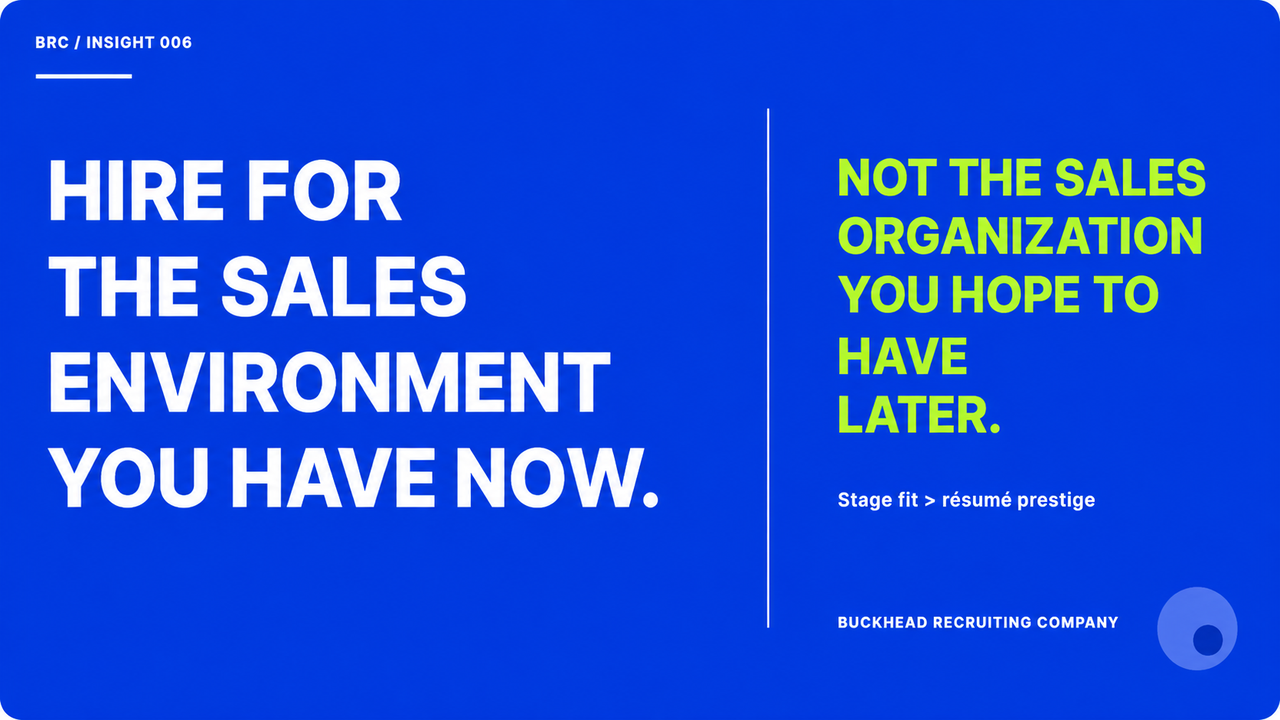
Hire for the sales environment you have now, not the sales organization you hope to have later.
Resources
The founder’s playbook for scaling to $1 million ARR - Bessemer Venture Partners
https://baincapitalventures.com/insight/founders-dont-hire-aes-until-youve-figured-out-how-to-sell-yourselves/?utm_source=chatgpt.com
Bessemer Venture Partners — “The founder’s playbook for scaling to $1 million ARR.